PuroAir 130i Smart Air Purifier: A Comprehensive Editorial Review for 2026
Indoor air quality concerns have escalated in recent years as research continues to document the health impacts of airborne pollutants, allergens, and volatile organic compounds within residential environments. The PuroAir 130i air purifier represents the manufacturer’s smart-enabled entry in the mid-range air purification market, targeting bedrooms, home offices, and medium-sized living spaces up to 600 square feet with Wi-Fi connectivity and multi-layer filtration technology.
This editorial review examines the PuroAir 130i from a strictly analytical perspective, evaluating its filtration specifications, smart features, operational performance, maintenance requirements, and overall value proposition. The analysis focuses on verified technical data, independent laboratory testing claims, and documented performance metrics without promotional bias or unverified customer testimonials.
Table of Contents
- Product Overview & Specifications
- Filtration System Analysis
- Coverage Area & Performance Metrics
- Smart Features & App Functionality
- Noise Levels & Operation Modes
- Design & Physical Construction
- Filter Maintenance & Replacement
- Energy Consumption & Efficiency
- Suitable Use Cases & Applications
- Competitive Market Positioning
- Warranty & Customer Support
- Final Editorial Assessment




Product Overview & Specifications
PuroAir positions itself as a health-focused air purification brand serving over 900,000 households and maintaining partnership status with the American Lung Association. The company emphasizes evidence-based filtration claims supported by ISO 17025 certified laboratory testing rather than relying solely on marketing assertions.
The PuroAir 130i air purifier occupies the entry tier within the manufacturer’s product lineup, sitting below the PuroAir 240 (1,000 sq ft coverage) and PuroAir 400 (2,000 sq ft coverage) models. The “i” designation indicates smart connectivity capabilities distinguishing it from the non-connected PuroAir 130 base model.
Technical Specifications
The unit measures 7.87 x 7.87 x 12.68 inches with a weight of 4.39 pounds, establishing a compact footprint suitable for placement on nightstands, desks, or floor spaces without significant spatial intrusion. This dimensional profile positions it among the smaller end of residential air purifiers while maintaining 600 square foot coverage capacity.
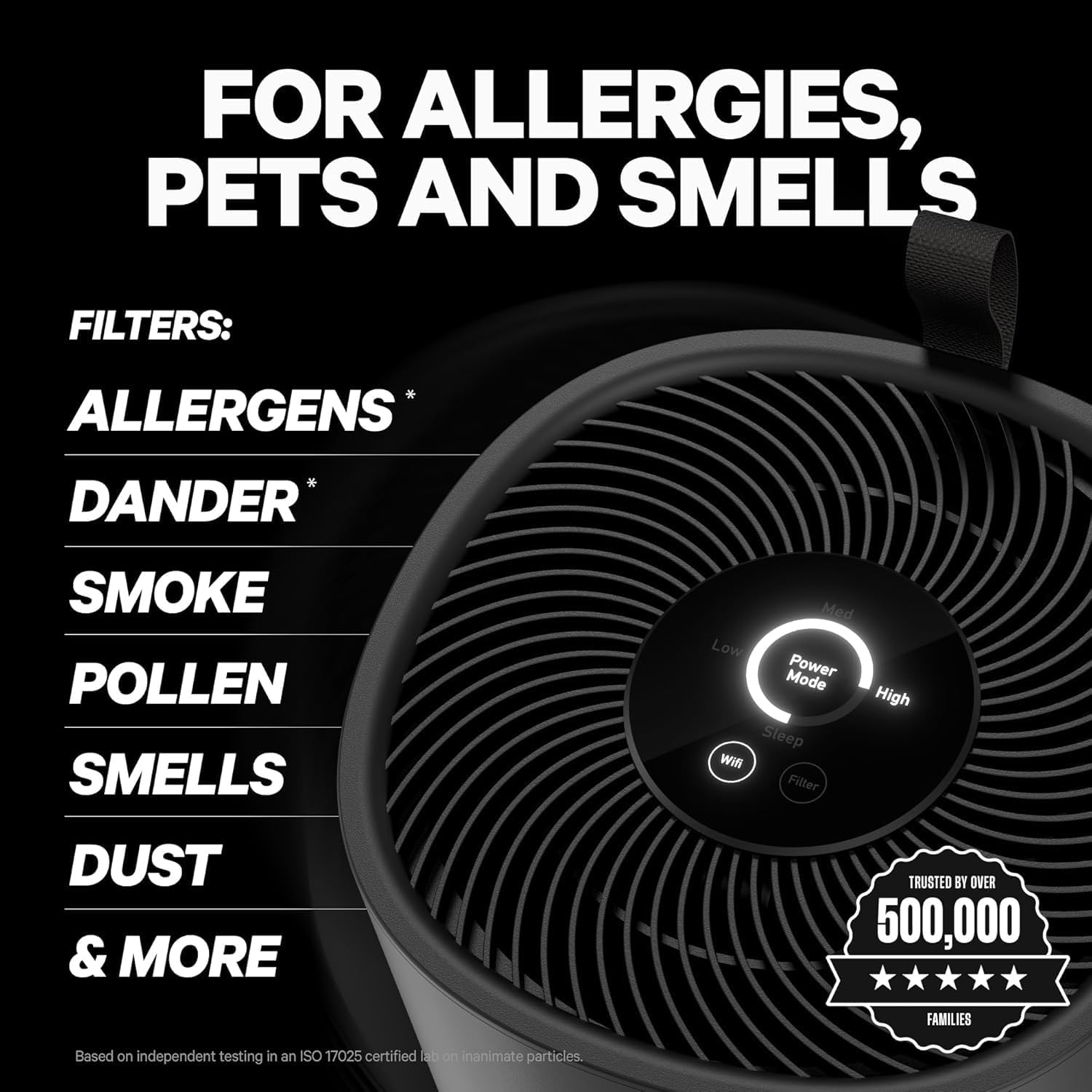
The purifier incorporates a 3-layer filtration system comprising a pre-filter screen, high-efficiency particulate air (HEPA) filter, and activated carbon layer enhanced with “CarbonTech” branding. The manufacturer claims this configuration captures up to 99.9% of airborne pollutants based on testing conducted in ISO 17025 certified laboratories using inanimate particles.
Clean Air Delivery Rate (CADR) specifications indicate 130 cubic feet per minute (CFM), which represents the volume of filtered air the unit delivers. This metric provides quantifiable comparison against competing models, though CADR ratings vary by particle type (dust, pollen, smoke) and testing methodologies.
Filtration System Analysis
The PuroAir 130i employs a three-stage filtration approach addressing different particle sizes and contamination types. Each layer targets specific pollutant categories based on physical filtration principles and chemical adsorption mechanisms.
Pre-Filter Layer
The initial pre-filter captures larger airborne particles including visible dust, pet hair, and lint before air reaches the primary HEPA element. This preliminary stage extends the operational lifespan of the more expensive HEPA filter by preventing large particle accumulation that would otherwise clog the dense HEPA media prematurely. Pre-filters typically handle particles above 1 micron in size.
HEPA Filter Stage
The core filtration layer utilizes high-efficiency particulate air technology claiming 99.9% capture efficiency for particles down to 0.1 microns. The manufacturer markets this as filtering particles “700X smaller than a human hair” based on average hair diameter measurements of approximately 70 microns.
True HEPA certification requires 99.97% efficiency at 0.3 microns—the most penetrating particle size (MPPS) where filtration faces greatest difficulty. PuroAir’s 99.9% claim at 0.1 microns suggests high-efficiency performance, though the 0.1 micron specification differs from standard HEPA testing protocols which focus on 0.3 micron particles. Independent verification of stated efficiency across the complete particle size spectrum would strengthen these claims.
The HEPA layer targets common household allergens including pollen (typically 10-100 microns), mold spores (3-40 microns), pet dander (0.5-100 microns), and fine dust particles. These particle sizes fall well within HEPA filtration capabilities based on established filtration physics.
Activated Carbon Layer
The final filtration stage incorporates activated carbon for adsorbing gaseous pollutants, odors, and volatile organic compounds (VOCs) that particle filters cannot capture. Activated carbon works through adsorption—chemical bonding of gas molecules to the carbon’s extensive surface area created through activation processing.
The “CarbonTech” branding suggests proprietary treatment or enhanced activation processes, though specific technical details regarding carbon source, activation method, or adsorption capacity are not publicly disclosed. Carbon filter effectiveness depends on carbon weight, surface area, contact time, and specific contaminants present—variables that require detailed specifications for performance assessment.
Common household odors from cooking, pets, and smoke contain different molecular structures requiring varying contact times and carbon characteristics for effective removal. Generic activated carbon layers show limited effectiveness against formaldehyde and other small VOC molecules without specialized chemical treatment.
Coverage Area & Performance Metrics
PuroAir rates the 130i for spaces up to 600 square feet, completing one full air change per hour (ACH) in rooms of that size. This specification assumes standard 8-foot ceiling height, yielding approximately 4,800 cubic feet of room volume.
Air change rate represents a critical performance metric for air purifier effectiveness. The Association of Home Appliance Manufacturers (AHAM) recommends 4-5 air changes per hour for optimal allergen reduction. At 600 square feet, the PuroAir 130i provides 1 ACH, suggesting users should target significantly smaller rooms (approximately 120-150 square feet) to achieve the recommended 4-5 ACH for allergy relief.
The 130 CFM CADR rating indicates moderate air movement velocity. For context, competing units in similar categories offer CADR ratings between 100-180 CFM for rooms of comparable size. Higher CADR values enable faster air cleaning but typically generate increased noise levels—a trade-off users must balance based on priority preferences.
Real-world performance depends on multiple variables beyond manufacturer specifications including room configuration, air circulation patterns, pollution sources, filter condition, and fan speed settings. Closed-door bedrooms with minimal air circulation may experience different results compared to open-concept spaces with ceiling fans or HVAC air movement.
Testing Methodology Transparency
The manufacturer references independent testing in ISO 17025 certified laboratories using typical residential ventilation rates. ISO 17025 accreditation indicates laboratory competence in specific testing methods, though the standard does not prescribe particular air purifier testing protocols. Users seeking detailed performance verification should request complete test reports including particle size distributions, loading conditions, and measurement methodologies.
Smart Features & App Functionality
The “i” designation in PuroAir 130i denotes integrated Wi-Fi connectivity enabling remote control through the manufacturer’s mobile application. This smart functionality differentiates the model from the base PuroAir 130 unit, which operates via manual touch controls exclusively.
Mobile Application Features
The PuroAir mobile app, available for iOS and Android platforms, provides several control and monitoring capabilities:
- Remote fan speed adjustment across multiple settings without physical unit access
- Automated scheduling for predetermined on/off times optimizing energy consumption patterns
- Filter life monitoring with replacement reminders based on operational hours and usage intensity
- Real-time air quality data display showing particulate matter concentrations (PM1, PM2.5, PM10) and VOC levels
- Voice control integration with Amazon Alexa and Google Assistant platforms
- Multi-device management for households with multiple PuroAir units
- Guest access sharing allowing family members independent control
- Energy usage tracking providing efficiency insights and operational estimates
Setup Process
Initial configuration requires downloading the PuroAir application, powering the unit, pressing and holding the Wi-Fi button for 10-15 seconds until indicator lights flash, then following in-app pairing instructions to connect the purifier to home wireless networks. The process follows standard IoT device connection protocols similar to smart thermostats and lighting systems.
Network compatibility requires 2.4 GHz Wi-Fi bands—many modern routers operate dual-band 2.4/5 GHz networks, and users must ensure the purifier connects to the appropriate frequency. Some mesh network configurations and enterprise-grade security protocols may present connectivity challenges requiring router setting adjustments.
Privacy and Data Considerations
Smart connectivity inherently involves data transmission between the device, manufacturer servers, and user smartphones. The application collects operational data, air quality measurements, and usage patterns to enable remote control and monitoring features. Users concerned about data privacy should review the manufacturer’s privacy policy regarding data storage, sharing practices, and third-party access before enabling smart features.
Noise Levels & Operation Modes
Acoustic performance represents a critical consideration for air purifiers intended for bedroom use, where noise during sleep hours directly impacts user comfort and product usability. The PuroAir 130i specifies noise levels ranging from 24 decibels (dB) to 52 dB depending on fan speed selection.
Noise Level Context
For reference, 24 dB approximates the sound of rustling leaves or a whisper at close distance, while 52 dB compares to moderate rainfall or background conversation. Most adults require sleeping environments below 30-35 dB for uninterrupted rest, suggesting the lowest fan settings would suit noise-sensitive sleepers.
Independent user reports indicate the purifier operates “very quietly” on low settings, becoming “noticeable” but not disruptive on higher speeds. Some users specifically prefer the white noise characteristics of higher fan settings as sleep aids, creating steady ambient sound that masks intermittent environmental noise.
Fan Speed Settings
The unit provides multiple fan speed options accessible through touch controls and mobile application. Lower speeds prioritize quiet operation at reduced air processing rates, while higher speeds maximize purification velocity with increased acoustic output—the fundamental trade-off in fan-based air purification systems.
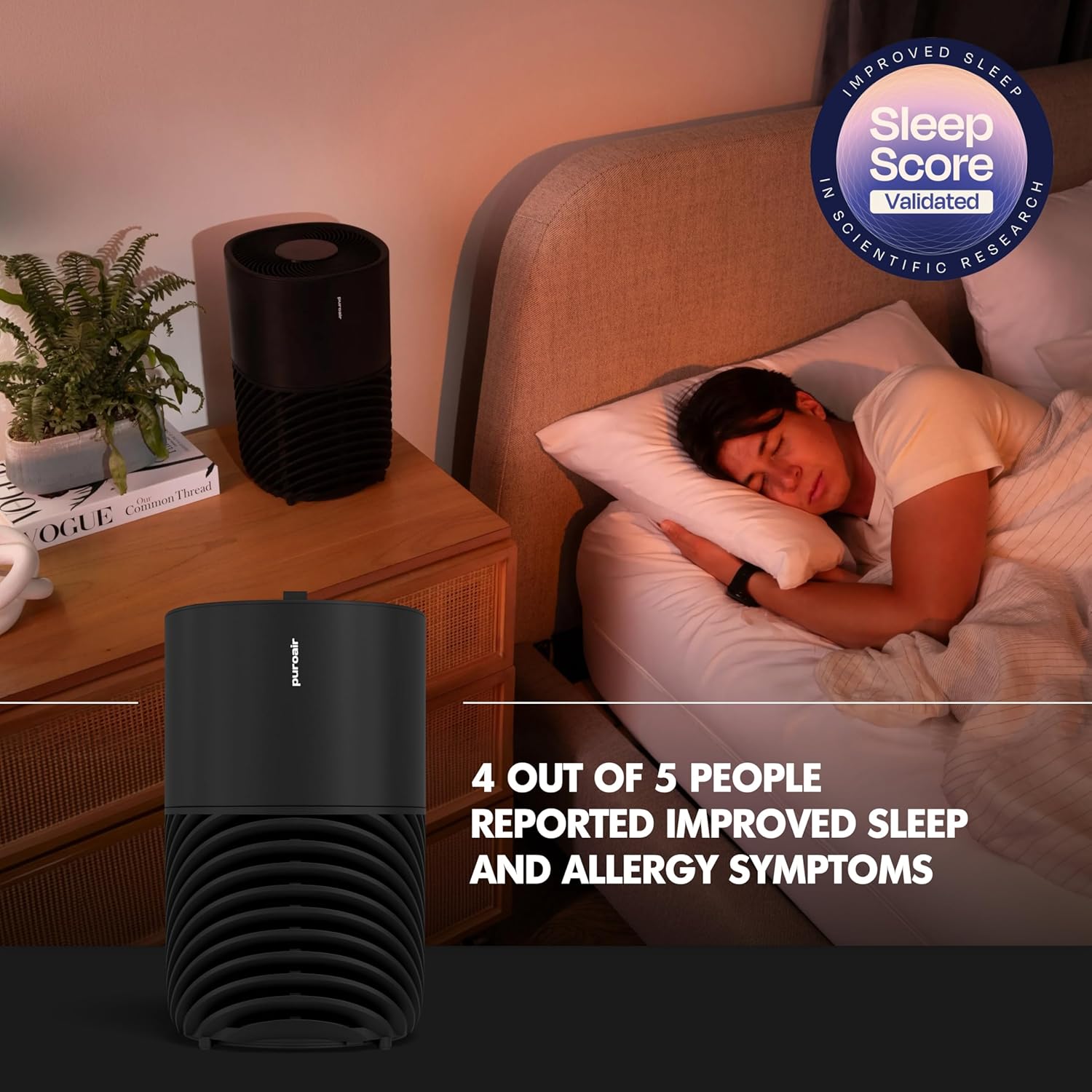
Sleep mode functionality dims display lights and operates at minimum fan speeds to reduce both visual and auditory disruption during overnight use. This feature addresses common user complaints about bright indicator lights interfering with sleep in darkened bedrooms.
Automatic mode adjusts fan speeds based on real-time air quality sensor readings, increasing airflow when pollution levels rise and reducing speeds when air quality improves. This intelligent operation balances purification performance against noise generation without requiring manual intervention.
Design & Physical Construction
The PuroAir 130i employs a cylindrical tower design with 7.87-inch diameter and 12.68-inch height. The compact vertical orientation minimizes floor space consumption compared to wider horizontal units, though taller designs require adequate clearance in enclosed spaces like cabinet shelving.
At 4.39 pounds, the unit qualifies as lightweight and portable, enabling easy relocation between rooms without physical strain. This mobility supports flexible placement responding to changing household needs—moving from bedroom to home office during daytime work hours, for example.
Material Construction
External housing utilizes plastic construction typical of consumer-grade air purifiers in this category. While metal housings offer superior durability and premium aesthetics, plastic reduces manufacturing weight and enables lighter portability. The material quality and finish durability through extended use represent factors determinable only through long-term field observation.
Intake and output vents positioned around the unit’s circumference facilitate 360-degree air circulation patterns. This omnidirectional design allows flexible placement without concern for directing airflow toward specific room areas, though positioning near walls or corners may impede intake efficiency.
Control Interface
The top-mounted touch control panel provides on-unit operation access for users preferring manual control over app-based management. Touch controls eliminate mechanical buttons that accumulate dust and debris, though capacitive touch sensors may prove challenging for users with limited dexterity or tactile feedback preferences.
LED indicators display operational status, fan speed, filter replacement alerts, and Wi-Fi connectivity. Display brightness adjustment or complete dimming through sleep mode addresses user concerns about light pollution in bedroom environments.
Filter Maintenance & Replacement
Ongoing filter replacement constitutes the primary recurring consideration in air purifier ownership. Understanding replacement schedules provides essential context for long-term maintenance planning.
Filter Lifespan
PuroAir recommends filter replacement every 3-4 months for optimal performance, though actual lifespan varies based on usage intensity, environmental pollution levels, and operational hours. The mobile application tracks filter life and provides replacement reminders based on runtime accumulation.
Factors accelerating filter degradation include heavy pet dander presence, smoking indoors, cooking activities generating airborne particles, proximity to high-traffic roads, and continuous 24/7 operation. Conversely, occasional use in clean environments may extend filter life beyond manufacturer recommendations, though users should not compromise effectiveness by extending intervals excessively.
The combined 3-layer filter requires complete replacement as a single unit rather than individual layer replacement. This integrated design simplifies the replacement process but prevents users from extending carbon filter life beyond HEPA filter degradation or vice versa.
Filter Availability
PuroAir-specific replacement filters require sourcing from the manufacturer or authorized retailers to ensure proper fit and performance specifications. The manufacturer offers filter subscription services through the mobile application, providing automated delivery. Subscription models reduce the inconvenience of remembering reorder timing but create ongoing commitments users should evaluate against one-time purchase preferences.
Filter Replacement Process
The replacement procedure involves removing the outer housing, extracting the exhausted filter, inserting the new filter, replacing the housing, and pressing the filter reset button for 5-10 seconds to clear the replacement indicator. The process requires no tools and completes in minutes without technical expertise.
Energy Consumption & Efficiency
Power consumption specifications indicate 40 watts maximum draw at highest fan speeds. For comparison, this approximates the energy usage of a traditional incandescent light bulb or modern LED television in standby mode.
Operating 24 hours daily at maximum power consumption (40W) would utilize 0.96 kilowatt-hours (kWh) per day or approximately 28.8 kWh monthly. Actual energy consumption varies significantly based on fan speed selection, with lower settings drawing substantially less power.
Sleep mode and automatic operation optimize energy usage by reducing fan speeds during periods of acceptable air quality, potentially cutting consumption by 50-70% compared to continuous maximum-speed operation. The mobile application includes energy tracking features displaying historical consumption patterns and providing efficiency insights.
Suitable Use Cases & Applications
The PuroAir 130i air purifier addresses specific use scenarios where its 600-square-foot coverage capacity, smart features, and compact design provide optimal value. Primary suitability categories include:
Bedroom Air Purification
The combination of quiet operation (24 dB minimum), sleep mode with dimmed displays, and adequate coverage for typical bedrooms (average 120-200 sq ft) positions this unit effectively for overnight use. Users report noticeable improvements in sleep quality when tested by SleepScore independent laboratories, though individual results vary based on existing air quality issues and personal sensitivity levels.
Pet Owner Applications
Pet dander represents particles ranging from 0.5-100 microns—well within HEPA filtration capabilities. Independent user testing specifically in bedrooms containing litter boxes reported “real improvement” in odor control and airborne dander reduction. The activated carbon layer addresses pet-related odors through adsorption, though carbon capacity limits exist requiring timely filter replacement.
Allergy and Asthma Management
Common allergens including pollen, dust mites, and mold spores fall within the particle size ranges targeted by HEPA filtration. The manufacturer’s American Lung Association partnership suggests alignment with respiratory health priorities, though this affiliation represents brand positioning rather than product-specific endorsement.
Users seeking allergy relief should target 4-5 air changes per hour recommended by air quality professionals. For the PuroAir 130i, this translates to room sizes approximately 120-150 square feet rather than the maximum 600 square foot specification, which provides only 1 ACH.
Home Office Environments
The unit’s compact footprint, quiet operation at lower speeds, and smart scheduling for business-hours activation suit home office applications. Desktop placement or under-desk positioning enables localized air cleaning in workspaces without monopolizing floor space or generating distracting noise during video conferences.
Unsuitable Applications
The PuroAir 130i shows limitations for certain use cases:
- Large open-concept living areas exceeding 600 square feet require either multiple units or higher-capacity models like the PuroAir 240 (1,000 sq ft) or PuroAir 400 (2,000 sq ft)
- Commercial or industrial environments with heavy particle loading or chemical exposure exceed residential filtration capabilities
- Medical-grade air purification for immunocompromised individuals may require HEPA filters meeting specific medical standards with documented performance rather than consumer-grade specifications
- Smoke removal from active smoking indoors overwhelms residential carbon filter capacity—these units target residual odors rather than continuous smoke generation
Competitive Market Positioning
The mid-range air purifier market includes numerous competitors offering similar specifications, coverage areas, and feature sets. The PuroAir 130i’s competitive differentiation centers on several factors:
Smart Connectivity
Wi-Fi integration and comprehensive mobile application functionality remain less common in entry-level air purifiers, where many competitors offer only manual controls or basic remote controls. The PuroAir app’s feature depth including scheduling, air quality monitoring, and multi-device management provides tangible value for tech-oriented users.
Filter Performance Claims
The stated 99.9% efficiency at 0.1 microns positions slightly above standard True HEPA 99.97% at 0.3 microns specifications, though direct comparisons require identical testing methodologies. Marketing claims regarding particles “700X smaller than human hair” translate to approximately 0.1 microns—within stated performance parameters but requiring verification through independent testing.
Brand Positioning and Support
PuroAir’s emphasis on American Lung Association partnership, ISO 17025 laboratory testing, and two-year warranty provides brand credibility markers differentiating from lesser-known manufacturers. The company’s claimed 900,000 customer base suggests established market presence, though independent verification of this figure remains unavailable.
Comparison Against Specific Competitors
The Levoit Core 300 offers comparable 200-220 sq ft coverage with True HEPA filtration at similar specifications but lacks built-in smart connectivity. Coway AP-1512HH provides higher CADR ratings and larger coverage but operates with different feature priorities. Blueair Blue Pure 211+ emphasizes minimal design and washable pre-filters but omits smart features entirely.
Warranty & Customer Support
PuroAir includes a two-year manufacturer warranty covering defects in materials and workmanship. This duration exceeds many competitors offering one-year standard warranties, though falls short of premium brands providing 3-5 year coverage.
Warranty terms typically exclude consumable components like filters, damage from misuse or unauthorized modifications, and issues resulting from failure to maintain the unit according to manufacturer specifications. Users should retain purchase documentation and register products to activate warranty coverage.
The manufacturer emphasizes U.S.-based operations and customer service team availability for addressing product issues. Response times, service quality, and problem resolution effectiveness represent factors assessable only through direct customer interaction or aggregate review analysis over extended periods.
Return policies and satisfaction guarantees depend on the retailer from which users purchase. Amazon purchases typically include 30-day return windows under standard policies, while direct manufacturer purchases may offer extended trial periods or guarantees requiring verification of specific terms.
Final Editorial Assessment
The PuroAir 130i smart air purifier represents a competent mid-range air purification solution emphasizing smart connectivity, compact design, and multi-stage filtration for residential spaces up to 600 square feet. The unit delivers functional value aligned with its market positioning, though users must apply realistic expectations regarding performance limitations and ongoing maintenance requirements.
Primary Strengths
The integration of comprehensive Wi-Fi control through a feature-rich mobile application distinguishes this model in its category. Users valuing remote operation, automated scheduling, and filter life tracking will find meaningful utility in these smart capabilities. The 24 dB minimum noise specification enables bedroom use without significant sleep disruption for most users.
The compact physical footprint and 4.39-pound weight facilitate flexible placement and easy relocation between rooms. Independent user testing confirms effective odor control in challenging environments like bedrooms with litter boxes, validating activated carbon functionality for common household odor sources.
Notable Limitations
The 600-square-foot maximum coverage provides only one air change per hour at that room size, falling significantly below the 4-5 ACH recommended for optimal allergen reduction. Users seeking maximum effectiveness for allergy management should target rooms approximately one-fifth the maximum coverage area or accept reduced air change rates.
The 3-4 month filter replacement schedule demands consistent maintenance attention. Performance claims referencing ISO 17025 laboratory testing lack publicly available detailed test reports including methodologies, loading conditions, and particle size distributions. Users requiring verified performance data should request complete documentation rather than relying on summary marketing specifications.
Suitability Determination
The PuroAir 130i best serves:
- Bedroom air purification for rooms 100-200 square feet where quiet operation and sleep mode functionality provide primary value
- Pet owners seeking dander control and odor management in concentrated living spaces
- Tech-oriented users prioritizing smart home integration, mobile app control, and automated operation
- Home office workers requiring compact, quiet air cleaning during business hours
- Users accepting mid-range filtration performance with smart features
The unit may prove less suitable for:
- Large open-concept living areas requiring high air change rates across extensive square footage
- Users demanding medical-grade filtration with comprehensive third-party verification documentation
- Individuals seeking minimal long-term maintenance requirements and extended filter replacement intervals
- Environments with extreme pollution loading exceeding residential filtration design parameters
Purchase Recommendation Framework
Prospective buyers should assess the following factors before purchase:
- Measure actual room dimensions to verify coverage adequacy—calculate square footage and compare against maximum specifications with appropriate margin for effective air change rates
- Evaluate smart feature utility based on lifestyle patterns—users rarely accessing mobile apps may find limited value in Wi-Fi connectivity
- Consider filter replacement schedules and long-term maintenance commitments
- Assess noise sensitivity levels and typical usage scenarios—bedroom applications demand different acoustic profiles than living rooms
- Verify filter availability through manufacturer and third-party retailers before commitment
- Review warranty terms and return policies specific to purchase channel
The PuroAir 130i accomplishes its design objectives of providing accessible smart air purification for small to medium residential spaces. Users aligning expectations with documented capabilities and accepting inherent limitations of mid-range filtration technology will find functional value. Those requiring extreme performance, minimal maintenance, or extensive coverage should explore higher-capacity alternatives.
As an Amazon Associate I earn from qualifying purchases.



No Responses